Can Human Design Help During Midlife? What It Can (and Can't) Tell You
Midlife has a way of dismantling identities that once felt solid. Careers stop fitting. Relationships end. The goals you've spent years working towards no longer feel meaningful. And the version of yourself you've spent decades becoming suddenly feels unfamiliar.
It's often in that space that people discover Human Design. We’re not necessarily looking for something to believe in, rather, we simply want to understand ourselves again. When life stops making sense, we don't just question our choices or our purpose. We start questioning ourselves.
So it's no surprise that one of the most common questions I see in the Human Design space is: "Is Human Design actually real?"
But I don't think that's the most interesting question to ask. A more useful one would be this: can Human Design actually help?
Here’s What We’ll Explore:
Why Human Design Often Finds Us During Midlife
What Human Design Can and Can’t Tell You
Why the Experiment Begins In the Body
A Simple Place to Begin and Where to Go Next
Why Human Design Often Finds Us During Midlife
By the time we reach midlife, many of us have become experts at functioning. We've built careers, cared for families, met expectations, and learned how to keep going even when something inside us feels off.
Eventually, though, that way of living can start to unravel. Burnout, major life transitions, health challenges, grief, divorce, children leaving home, or simply the quiet realisation that the life we've built no longer feels like our own can leave us wondering who we are beneath all the roles we've been playing.
It's often in that space that Human Design appears.
It offers a different way of approaching the questions midlife raises. Instead of asking how to get back to how life used to feel, Human Design invites us to enquire whether that life fit us in the first place.
When I first discovered Human Design, I approached it the way I had approached so many other personal development tools: I wanted it to explain me. I hoped it would finally tell me why I felt the way I did and what I needed to do to get my life back on track.
At first, it felt like it did. There was a deep sense of recognition. Parts of myself I'd struggled to put into words suddenly had language. But over time, something became clear: understanding my chart wasn't the same as understanding myself.
The frustration I was carrying didn't disappear just because I knew my Type or Authority. My patterns were still there. My habits of overriding myself were still there. I knew I was missing something but I didn’t quite know what.
That was the moment my relationship with Human Design began to change. I realised that the question about the realness of Human Design often distracts us from the deeper inquiry: can Human Design help us live a more honest life, one that actually feels like we’re living our purpose?
Throughout that process, it stopped being something I was trying to prove or figure out, and became a way of observing my own experience with greater honesty.
What Human Design Can Tell You
One of the biggest misconceptions about Human Design is that it's designed to tell you who you are. I don't think that's its greatest strength.
To me, Human Design is most useful as a self-reflection tool. It doesn't hand you a new identity to adopt. It gives you a way of noticing how you're already relating to yourself.
It helps you become aware of the moments when you're overriding your own capacity, saying yes when your body means no, chasing someone else's definition of success, or making decisions from fear rather than from a place of inner stability.
This is why Human Design can feel so powerful during midlife. As old identities begin to fall away, it offers a language for patterns you may have been living for decades without consciously seeing. It can highlight where you've adapted to meet expectations, where you've learned to prioritise certainty over self-trust, and where you've become disconnected from your own way of moving through the world.
For me, that shift was less about discovering who I was and more about recognising how often I was abandoning myself. My chart didn't create those patterns. It simply helped me spot them more clearly.
That's where I believe Human Design offers its greatest value. It’s not necessarily a system that gives you answers, but as one that helps you ask better questions.
What Human Design Can't Tell You
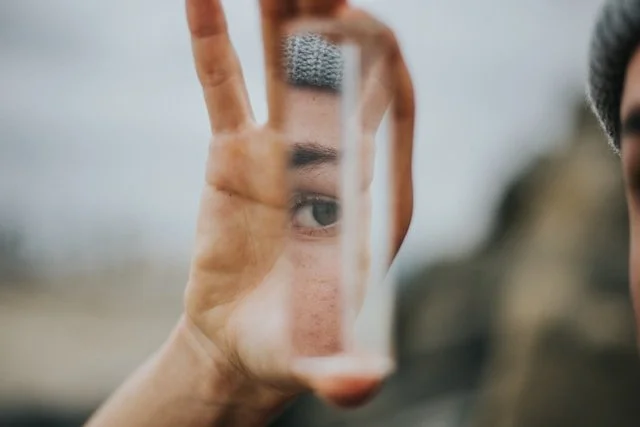
The other side of this conversation is just as important. Because while Human Design can offer a powerful mirror, it cannot become a substitute for your own relationship with yourself. It won’t tell you exactly what decision to make.
It won’t tell you which career path to choose, who to be in a relationship with, or what your life purpose is supposed to look like. It cannot remove uncertainty from being human. And yet, this is often where we can unintentionally turn Human Design into another form of self-abandonment.
When life feels uncertain, it is natural to search for something that can give us certainty. We want to know we're making the right choice. We want reassurance that we're on the correct path. We want someone, or something, to tell us who we are.
But the deeper invitation of Human Design is to develop a more intimate relationship with our own experience.
This can be especially challenging in midlife, when so much of what once gave us a sense of identity starts shifting. When the old ways of measuring success stop working, it can feel tempting to replace one external framework with another.
But it’s worth reminding ourselves that our chart is not a set of instructions we have to follow perfectly. It’s not another standard we need to measure ourselves against. Simply put, it’s an invitation to observe ourselves more honestly.
And that honesty is not always comfortable.
Sometimes it reveals the places where we've been forcing, performing, or adapting for so long that those patterns have started to feel like who we are. And observing those patterns is exactly the beginning of returning to yourself.
The Experiment Begins in the Body
This is why I no longer see Human Design as something to master intellectually. Knowing your chart is not the same as knowing yourself.
The real experiment begins when you start paying attention to your lived experience. You begin noticing how your energy changes throughout the day. You recognise the moments when something in your body contracts before your mind talks you into saying yes. You become curious about what actually leaves you feeling nourished, connected, and alive, rather than what you think should.
For me, this has been one of the biggest shifts in my own experiment.
I stopped trying to become the person I thought my chart was describing and started observing the person I already was. Instead of asking whether I was "doing my design correctly," I became more interested in how my body responded to different choices, environments, relationships, and ways of working.
That change in perspective transformed Human Design from a set of ideas into a lived practice. And it’s where my work has gradually expanded beyond Human Design alone.
If your body doesn't feel safe enough to notice what's true, it becomes incredibly difficult to distinguish your own signals from old survival strategies. We can mistake hyper-independence for authenticity. We can confuse people-pleasing with kindness. We can believe we're following our Authority when we're actually responding from fear or habit.
That's why I see the body as the bridge between understanding your chart and living it.
Human Design may point towards your natural way of moving through life, but it is your lived experience that teaches you what that actually feels like.
A Simple Place to Begin
If there's one thing I'd love you to take away from this article, it's this: Human Design doesn't ask you to become someone new. It invites you to remember the person you've been beneath years of adaptation.
If you're wondering where to start, don't worry about knowing every nook and cranny of your chart. Instead, begin with simple observations.
Ask yourself:
Where am I overriding myself right now?
What expectations am I still trying to live up to?
What changes when I listen to my body before my mind?
Where have I confused survival with authenticity?
What feels genuinely true in this season of my life?
You don't need to answer all of these questions today. Sometimes simply becoming aware of them is enough to begin seeing yourself differently.
Because ultimately, I don't believe Human Design exists to offer us certainty. Life will always ask us to navigate the unknown. What it can offer is a way of meeting that uncertainty with greater self-awareness, deeper self-trust, and a more honest relationship with yourself.
And for me, that's where its real value lies.
Where to Go Next
Human Design can help you see yourself more clearly, but understanding your chart is only the beginning. The deeper work is what I call Embodied Deconditioning: the gradual process of shedding survival patterns and returning to yourself. Read How Human Design Can Help You Navigate Midlife Transitions.
Hi, I’m Silvia Poldaru. I work with Human Design through the body, supporting deep feelers and overthinkers who are moving through burnout, identity shifts, or midlife transitions to reconnect with their own lived truth. Curious to learn more about who I am and why I do this work? Read more here.
The image credit goes to Vince Fleming from Unsplash.